Some feel the urge to bring all the different social spheres of which they’re a part into a single fold, and have unusual combinations of people meet each other. They reflect on the totality, the diversity, of their life, and find it strange. And they should, because life is strange. And this is a fair and common and true belief.
I don’t necessarily share that impulse. But I do have an analogous impulse, which is – to bring all my fields of study, all my thoughts, together, in these long rambling essay moments, to create a new way of looking at things. My life is structured in such a way that the first impulse – to bring all the people I know together – is almost impossible. Probably it’s this way for you, too. But I think the second impulse is possible. With that in mind, I should like to develop some amniotic thoughts on truth, ritual, religion and the law.
Basic levels of truth
It seems to me there are multiple levels of truth. Not all are equal or equally true.
There is instinct, first of all. Less than a truth – less even than a developed thought. A moving impulse. Found somewhere in the brain stem.
Then, there’s heuristic, generalisation, stereotype. Some form of (general perceived) fact is present – but it’s not applied. (I.e. to the situation.)
Then there’s suspicion. Now we’re dealing with a heuristic applied to a situation (an apparent fact). But there’s insufficient consideration, application, for the thought to reach the status of fact.
Then you have fact. And fact is – what’s sighted. An objective event. Let’s ignore, at least for now, all the possible directions that thought can go. Objectivity, subjectivity, etc. Those discussions are possible elsewhere.
You might wonder why I assigned all those earlier stages the character of truth. I might deal with that another time.
Hyper-fact
Now, secular logic tells us there’s nothing beyond this. Fact is fact. And facts may be subjective. Early 20th century. Etc. If the speaker is adequately equipped, they may use the word ‘quantum’ here. I of course disagree with this train of thought, as I disagree with many secular tenets.
The next level – yes, the next level of reality, above fact – is truth. How can there be a level of reality ‘above’ fact? you ask. Facts are reality. This is the territory of metaphor. Truths are expressed, analogous to facts but false facts. The great novels operate on this level of truth. Those axes, swinging wildly and cracking open the ice of our hearts, contain false events, but human truths – expressions of the human condition, of pure life beyond fact. They are closer to reality than fact because fact can be misinterpreted – but metaphor and human experience, when we recognise it, is always perfectly true. If it were not, we wouldn’t recognise it, we wouldn’t see it in the work and it wouldn’t be a great work.
May I digress for a moment. The utter chaos and inexpressibility of human life, of even one human life with its billions of perceptions and thoughts and the representations made to it – how could you hope to express this? It’s enough to drive anyone to despair. All writers are stark raving mad for trying to do it – some just blend in better than others. And those who manage to capture even a fingernail’s worth of the human experience – we call genius. Nobody could possibly express all of life through one artwork. Scott Walker’s album Scott 3 doesn’t deal with everything in existence. It has to limit itself to the fingernail. Everything good limits itself. All essays have a point (which I am aware I am straying from – we will return). Limitation is the condition we set ourselves to avoid the despair of not being capable of being God. We back away from eternity and decide to settle for creating one fingernail’s worth of experience.
Excess metaphor; fact-checking
There is a downside to metaphor however and that is that some will prioritise metaphor at the expense of fact, rather than treating it as a ‘hyper-fact’.
A view I once held and that others still hold: “I don’t care whether it happened, so long as it’s true.” I believed narratives were the most important thing, and even fact was subject to them – maybe as a reaction to the overly nitpicky and often left-leaning so-called ‘fact-checking’ crusades that peaked a few years ago. Such events tend to make one suspicious of the importance of objective reality especially when thinking about trees falling in unobserved forests and so on (i.e. whether an event without an effect is really an event).
Frankly however things are true and things are real and these may be different phenomena but they are of equal importance because the substrata of narrative, or metaphor, is reality i.e. fact. Metaphor is hyper-fact and can’t exist without that clay. Things should be known and be correct. Facts should be verified. (Yes, this is a value judgement in a descriptive context. There’s no rigour here. This is an essay. Difference between an essay and a paper? In a paper, you cite rigorously. Ironically for an essay about fact, I haven’t cited jack.)
It’s quite difficult to argue about this because it’s so fundamentally obvious but we tend to lose sight of it in the ongoing culture discussions. I think one reason for this is the kind of ‘fact’ that gets discussed.
It’s not that facts are unimportant to a person who believes in narrative. It’s that the broader meaning and significance of those facts is often ignored or incorrectly ascribed. Reflexively, reactionaries entirely dismiss the utility of facts. The kinds of facts that are spoken about, the kinds that are checked, are the sort of general large-scale statement of a Trump figure who is voicing a deeper problem but exaggerating a specific value for rhetorical effect. It’s widely felt most fact-checks miss the point: no one cares if the American president inflates a number to self-aggrandise. What’s important is whether the sentiment behind the statement is true. And given a president is almost always a position – this is the nature of the position – that forces self-aggrandisement, it’s widely understood his statements should contain puffery.
That pronouncements from a head of State are encomiastic about the achievements of that State is not revelatory. It’s not deserving of hysteria. It should be accepted as a preposition before the actual statement is received. All current states of affairs justify their impositions of atoms on the great nothing. Some choose to do it by bluffing, others with hard work, and some with the mere excuse that nothing else would go where they go.
But we have left the topic. Fact-checking as an institution is suspect and there are always tree-forest arguments going around, and when those are subverted there are underlying epistemological arguments about the meaning of truth and multiple truths and other similar flummery. None of this is important or worth consideration in the face of simple fact. A person wants to get something done. To what does he pay attention? The fact that knowledge is unknowable and that we live trusting the chemicals in our brains to tell us they’re chemicals? Or the fact that he can see the leaking pipe, touch it and possibly fix it?
So you see, fact is important – very important. It doesn’t do to throw it away for the sake of narrative or to score a point in the moment.
Above metaphor
Truth does not end here. Because truth is intimately tied to fact, there must be a referral from the metaphor to the reality. A factual link, a link of reality. The next level creates this link by looping back from metaphor to fact/reality – when we allow our own metaphors to turn upside down and influence reality again. This is called ritual – ritual is the ultimate level of truth.
Ritual – where we assume something to be the case which we cannot prove; where we adopt a number of axioms that fully guide what we believe and do; when we enforce those axioms in our behaviour; when abstraction is made physical. Ritual – where we act according not to our own design, but at the behest of a process, a metaphor, an abstraction of human behaviour to the highest imaginable level, where what we are actually doing can only be explained through metaphor, and the metaphor can only be explained by what we’re doing.
The church, and the courtroom, are sacred places. Rituals are performed within.
In the land of ritual all the facts we need are affirmed beforehand. Jesus Christ died on the cross; the parties have tendered all their submissions. All the steps are known and repeated a thousand times. Every step, every sneeze, echoes a million prior. The officiants don their vestments – robe or suit, hat or wig. The priest blesses the congregation; the judge enters the room and all rise. Arguments are made, the lawbooks are referred to; the gospels are read out. Finally the ultimate truth is reached – the
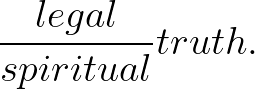
In court something is not true just because it is true. For it to be legally (ritually) true it must be purified, must enter the ritual space.
Both these types of ritual truth – and there are others – are presumed to exist on a higher level of reality than regular truth. Before it is admitted as evidence in a court of law, a fact must be attested to in a witness statement, must be cross-examinable; according to Christianity, to be considered divine truth a statement must be connected to the divine law, i.e. the Bible.
These ritual truths are used to carry out a series of abstract actions, ultimately with practical purposes. One saves the soul, the other dispenses justice.
These processes are the height of abstract human experience, but they’re touching on things so fundamental to our existence they can’t be ignored. There’s a disconnect between our experience (immediate, visceral, emotional) and how we collectively interpret and deal with that experience (by ritual, by fact-finding or prayer, by abstract consideration) that I, personally, find endlessly interesting.
It’s something like – the gap between what we are, and what we aspire to be. But what we aspire to is a part of what we are, of course. Perhaps, more accurately: the gap between what we appear to be, and what we aspire to be.
Interlude on jokes
I’ve noted in the past there’s a particular humour in much legal writing. There’s a sort of wry, knowing tone that manifests in some of the phrases you find in judgments like ‘the parties conferred outside the hearing room and were unable to come to an agreement’.
Now, that’s not funny. But if you keep the camera rollin’, (Jack Nicholson, to Matt Damon, on set for The Departed. See, I’ve cited Jack now) if you know the context – which is that they took a five-minute break, and one of them called the other one a fuckwit and threatened to drown him in a pool of custard – it is funny. What makes it funny (and I’m sorry to dissect a joke like this) is the disconnect: the total dryness in the result, the shown thing, ‘unable to come to an agreement’ that in no way reveals the true absurd drama. The essence of jokes might be concealment. A thought for another time.
Hyper-fact as the stuff of human life
How many of our activities are preparations for and recovery from ritual? Ritual might be the meaning of human life. The ultimate version of reality, where we impress our understanding given to us by the world back on the world again, where we subject the physical to the mental. Where we make the ought an is. Maybe everything revolves in an abstract way around some kind of ritual. It’s arguable, I think.
We’re all moths flitting around a church candle. That’s the drama of life.
You’re just a moth: how can you keep a candle flame lit?
Are all our outward expressions rituals?
The real human emotion – the real human event behind the faceless administrative process – I think about all the time. How much do we hide from others; how much can’t we express? We all know countless unspeakable ironies. Of all our experience, only the fingernail is expressed; only the admissible evidence is said in the courtroom that is society. The human drama that drives a court appearance is often invisible, buried under the ritual of law, evidence, cross-examination, point counterpoint. Wovon man nicht sprechen kann…your internal life – it’s something for you to know alone. You can only show us the ritual of yourself.
Does that drive you to despair? Or should you find it funny? I think that depends on you.
Addendum
This is an addendum that really doesn’t fit elsewhere.
To speak about my own preferences and interests: anything outside the realm of the technical, of the real, is of essentially no interest to me. This statement is easily misunderstood. Technicality (and keep in mind the root of that word, because I always use it with that in mind) demands wisdom; demands worldly engagement, demands practicality. I have never read Kant or Wittgenstein. I will never read most of the great works of either political or especially abstract philosophy. I acknowledge their value, but I learn the gist secondhand. My reading them in full has absolutely zero utility. It saves a great deal of bother. To know what not to learn: this is wisdom too.
I am ultimately interested in only four things: the performance and the background of ritual (meaning and its intersection with action), the physics of human operations (human and natural history, biology, the sciences), the psychology of narratives (imagination, reality and their intersection, human relations), and the philosophy of ethics (what we should do about being in this world).
These topics continue to lead me through an unquantifiable study of life which shall end only…
 verso folio